Service
From Abstract Concepts to Concrete Lessons: How Augmented Reality Makes the Unseen Visible
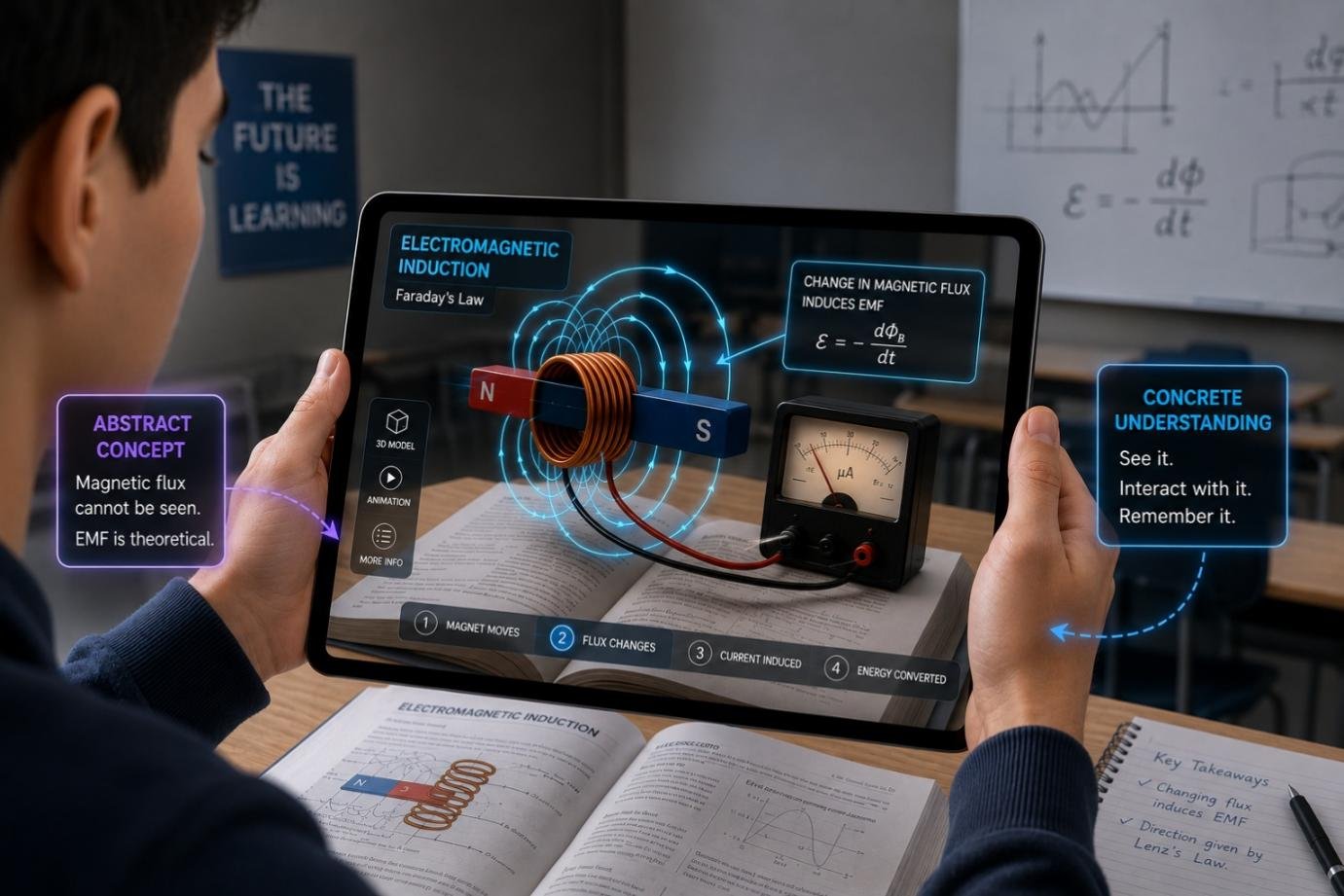
How Specto.xr's AR learning experiences turn invisible systems and abstract theories into interactive 3D lessons students can explore.
Have you ever tried explaining how a magnetic field works without being able to see it? Or asked students to imagine a complex 3D mathematical curve while looking at a simple 2D diagram? For many learners, understanding invisible systems and abstract theories is one of the biggest challenges in education. Textbooks, diagrams, and traditional classroom methods often require students to mentally transform flat information into three-dimensional concepts — a process that can be difficult even for talented learners.
This is where Augmented Reality in education is creating a revolutionary change. By combining digital technology with the real world, AR transforms complicated ideas into interactive 3D experiences. Students are no longer limited to reading about concepts — they can visualize, explore, and interact with them. Through innovative AR learning solutions, Specto.xr helps transform abstract ideas into practical experiences, making education more engaging, understandable, and memorable.
For centuries, education has depended on traditional learning tools such as blackboards, textbooks, printed diagrams, and digital presentations. These methods have successfully delivered information, but they have limitations when explaining concepts that cannot easily be observed. A student studying the structure of a human cell cannot physically see its internal components. A physics student cannot directly observe magnetic fields surrounding an object. A mathematics student may struggle to understand complex geometric transformations through numbers and formulas alone.
In these situations, students must both understand the information provided and create a mental visual representation of how that concept works. This additional mental effort can lead to confusion, frustration, and memorization-based learning instead of true understanding. Students may remember formulas, definitions, and steps, but they often struggle to understand the real-world applications behind them. The challenge isn't always the complexity of the subject — sometimes it's the limitation of the learning medium.
Augmented Reality solves this challenge by bringing digital information into the physical world. Instead of imagining a concept, students can experience it. With AR-powered learning experiences, a biology student can examine a rotating 3D DNA structure, a medical student can explore human anatomy models, and a physics student can visualize forces and movements that are normally invisible. Specto.xr's AR education solutions let learners interact with digital models by viewing them from different angles, exploring details, and understanding relationships between elements.
In biology and medical education, complex biological structures become interactive 3D models — DNA structures, human organs, cell functions, and anatomical systems — so instead of memorizing diagrams, learners understand how these systems exist and function in the real world. In mathematics and geometry, many students struggle to visualise concepts that exist only as numbers and equations; AR helps them understand 3D shapes, geometric transformations, symmetry, and mathematical curves by interacting with virtual objects, building a stronger spatial understanding.
In physics and science, many important concepts are invisible — magnetic fields, atomic structures, forces and motion, and energy systems — and AR lets students observe these principles instead of only reading theoretical explanations. AR also opens possibilities beyond science: in history and social studies, students can explore historical locations, ancient civilizations, battlefield recreations, and cultural artifacts, transforming history from a collection of dates and facts into an immersive learning journey.
The human brain processes visual information differently from written information — images, spatial relationships, and interactive experiences help learners build stronger mental connections. When students interact with visual learning environments, they spend less time trying to imagine concepts and more time analyzing, questioning, and understanding them. Augmented Reality improves learning by increasing student engagement, improving concept retention, encouraging curiosity, and supporting different learning styles, since some students learn better through reading and others through visual and practical experience.
A common misconception is that technology will replace traditional teaching methods. But the future of education isn't about replacing teachers — it's about giving them better tools. Teachers remain the most important part of the learning process because they guide discussions, explain ideas, and support students; Augmented Reality simply enhances their ability to demonstrate difficult concepts. Instead of saying “imagine this structure,” teachers can now say “let's explore it together” — creating a more interactive classroom where technology supports human knowledge and creativity.
The education industry is moving toward more personalized, interactive, and technology-driven learning experiences. As smartphones, tablets, and AR devices become more accessible, Augmented Reality will continue transforming classrooms, training programs, and educational platforms. Future learning environments won't just provide information — they'll let students experience knowledge, from science laboratories to virtual museums, as AR continues breaking the boundaries between imagination and reality.
At Specto.xr, we believe technology should simplify understanding, not complicate it. Our mission is to create immersive digital experiences that help organizations transform ideas into interactive realities. Through Augmented Reality solutions, we're helping businesses and educational institutions create engaging experiences where complex concepts become easier to understand — learning that is interactive, immersive, and experiential. With Augmented Reality, the concepts that once felt impossible to visualize can become experiences students can see, explore, and understand. Specto.xr is helping turn invisible ideas into visible possibilities.